Australian wine production has fallen below sales helping to reduce national inventory – but oversupply presents continuing challenges amid softening demand.
The Australian wine industry produced less wine than it sold helping reduce excess stock in 2025-26, according to Wine Australia’s latest Production, Sales and Inventory Report.
The 2025-26 findings indicate the sector has made progress in reducing stocks, but further adjustment is likely to be needed to move to a more sustainable supply and demand balance amid challenging trading conditions globally.
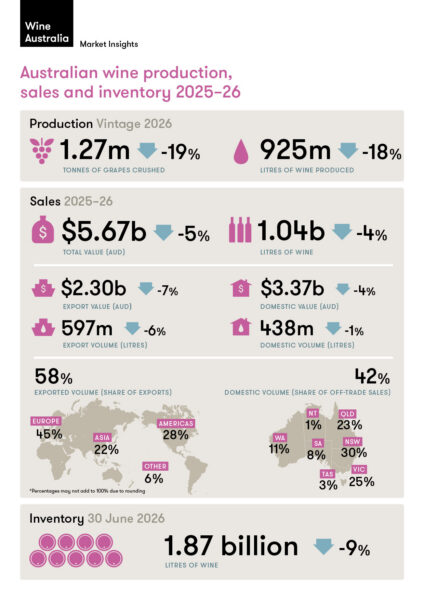
The national wine inventory fell by nine percent in 2025-26 to 1.87 billion litres, the lowest level since 2019-20 and below the 10-year average.
Red wine stocks declined by 15 percent, while white wine inventories remained largely unchanged.
Production fell sharply in the year, with the smallest winegrape crush in more than 25 years leading to total wine production of 925 million litres, equivalent to approximately 103 million 9-litre cases, a decline of 18 percent compared to 2024-25.
Total Australian wine sales fell four percent to 1.04 billion litres, reflecting softer domestic and export demand amid changing consumer preferences, cost-of-living pressures and declining global wine consumption.
Wine Australia Market Insights manager Peter Bailey said the latest figures point to an industry that is gradually working through excess inventory but continues to face difficult trading conditions.
“The sharp reduction in production has helped bring stock levels down, particularly for red wine, but demand remains subdued both in Australia and in many of our key export markets,” Mr Bailey said.
“While production once again fell below sales in 2025-26, helping reduce inventories, stock levels are still above what would generally be considered ideal.
“That means downward pressure on grape prices is likely to persist for some time.”
The national stock-to-sales ratio (SSR) fell by five percent in 2025-26 to 1.81, down from a peak of 2.13 in 2021-22.
However, it remains seven percent above the 10-year average of 1.69.
“Based on sales in 2025-26 and the 10-year average SSR, there is an excess of around 124 million litres of wine in stock,” Mr Bailey said.
“However, this should be viewed in the context that the 10-year average itself includes five years of industry oversupply.
“Prior to the record 2021 vintage, the average SSR was lower at 1.46.”
While the national stock-to-sales ratio improved and red wine stocks moved closer to historical norms, the white wine stock-to-sales ratio increased for the second consecutive year, indicating a supply trend to watch.
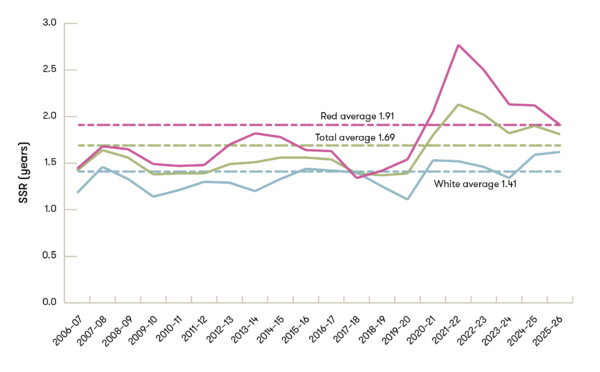

Stock-to-sales ratio for wine by colour 2007-2026 and 10-year averages.
Mr Bailey said structural shifts in global wine consumption were continuing to reshape market conditions.
“Consumers around the world are drinking less wine, particularly at lower price points, and that trend is affecting many of Australia’s key export destinations including the United Kingdom, United States and China,” he said.
“There are opportunities emerging in parts of Asia, where wine consumption is still growing, but growth in those markets is not yet large enough to fully offset declines elsewhere.”
Looking ahead to vintage 2027, Wine Australia expects winegrape prices to remain below long-term averages as the sector continues adjusting supply to match demand.
“The industry has made progress in reducing excess stocks, but further adjustment is likely to be required. Until supply and demand return to a more sustainable balance, profitability will remain under pressure for both grapegrowers and winemakers,” Mr Bailey said.
The Australian wine Production, Sales and Inventory Report 2025-26 showed:
• The 2026 winegrape crush is estimated at 1.27 million tonnes, down 19 percent on the previous vintage and 25 percent below the 10-year average.
• Total wine production declined by 18 percent to 925 million litres, equivalent to approximately 103 million 9-litre cases.
• Red wine output fell 28 percent to 428 million litres, the lowest level since the early 2000s.
• White wine production declined by a more modest eight percent to 498 million litres, overtaking red wine production and accounting for 54 percent of total production.
• The national stock-to-sales ratio, a key measure of balance between supply and demand, improved from 1.90 to 1.81 years of stock. Red wine stock levels moved closer to historical norms, but white wine stock-to-sales ratios increased for the second consecutive year.
• Domestic sales of Australian wine fell by one percent to 438 million litres, the lowest level recorded since 2005-06.
• Export volumes declined by six percent to 597 million litres, marking the first time exports have fallen below 600 million litres in more than two decades.
The Australian wine Production Sales and Inventory Report is based on the Wine Production, Sales and Inventory survey, conducted annually by Wine Australia.
The largest wineries are surveyed, accounting for approximately 77 percent of total wine production, and national estimates are derived from the survey results.
The numbers are an overall indication of the sector’s position at the end of the 2025-26 financial year, but do not reflect regional variations or individual business situations.
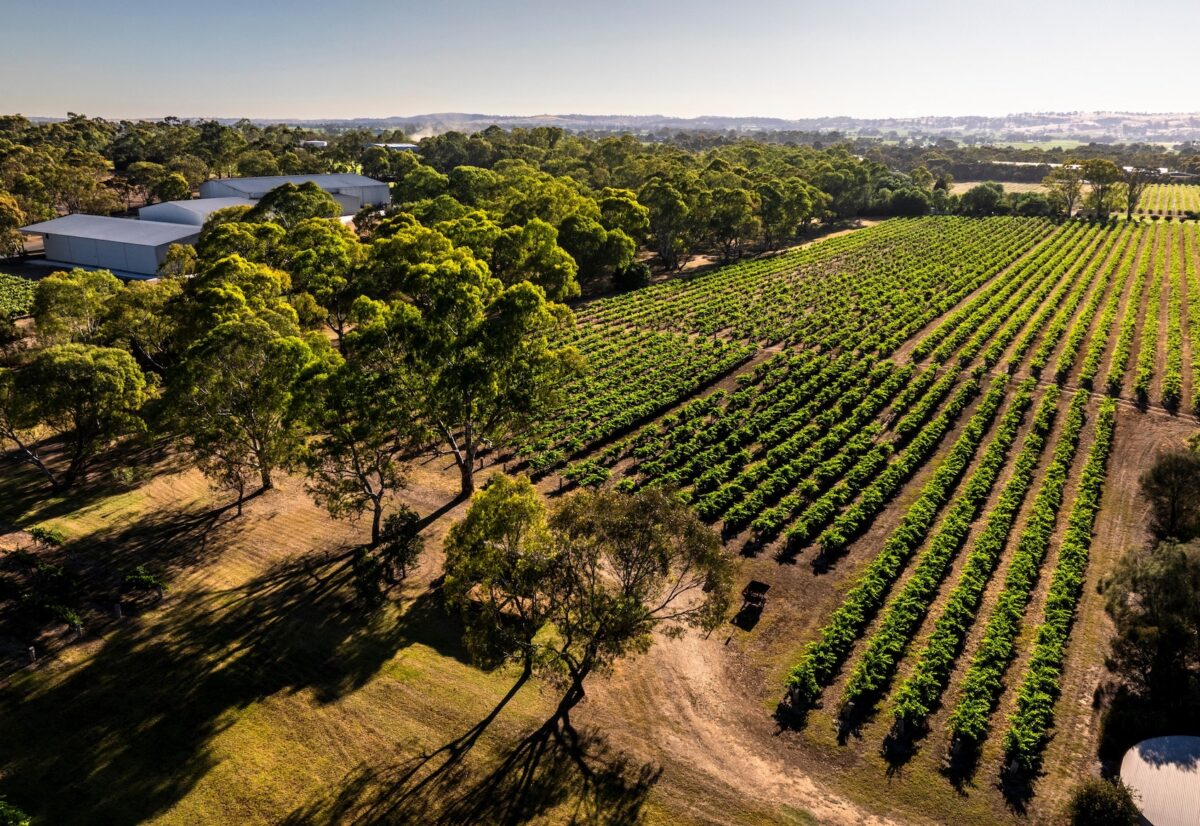
Photo: The Freedom 1843 Vineyard at Langmeil in the Barossa. Used for illustration purposes only.