


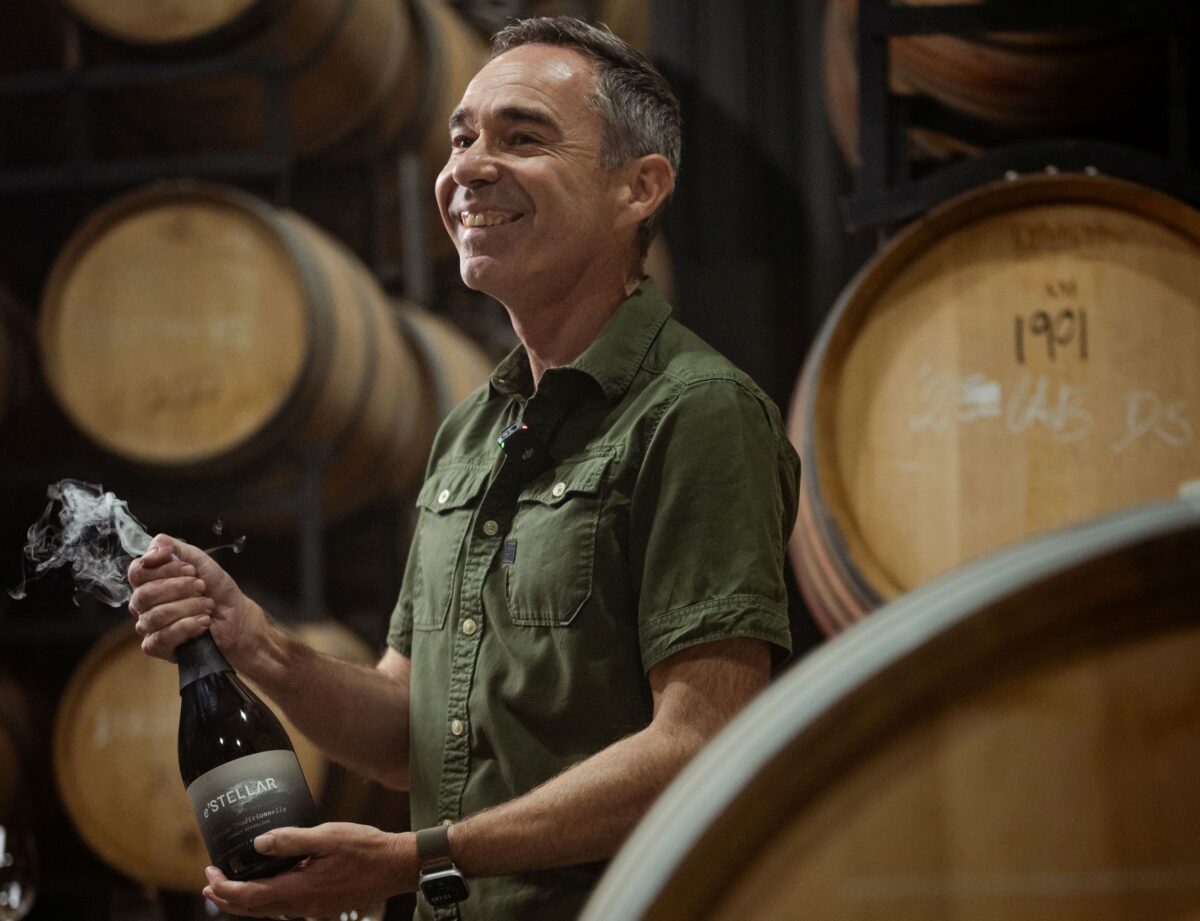
The first wines from the new e’Stellar Estate winery at Dixons Creek in the Yarra Valley have been released.
The brand and assets are owned by Joe and Cathy Casella and family – which is separate to Casella Family Brands.
It brings together two historic properties into a single 40-hectare vineyard operation – Dixons Creek Estate, established by the Jimmy Watson Trophy winner and pioneering Yarra Valley winemaker Graeme Miller, and the adjacent former Mandala vineyard, originally planted by the Henkell family in the 1980s.
For general manager and winemaker Martin Siebert, whose background includes working alongside Benjamin Leroux in Burgundy, Pegasus Bay in New Zealand, and two decades at top-tier Yarra institutions like Yarra Yering, Coldstream Hills and Tokar Estate, the venture represents a rare viticultural privilege.
“This is a carefully considered consolidation of two incredible histories,” he says.
“Graeme Miller, Henkell and Mandala all proved that this specific pocket of Dixons Creek can produce world-class wines.
“Looking at this combined 100-hectare site (of which 40 hectares are under vine) as a single canvas allows the winemaking team to achieve granularity across the site that is rare for smaller-scale producers, and thus, a release with both estate-wide and the much more parcel-specific e’Stellar range first go.”
Farming this terrain presents clear viticultural hurdles.
This geological footprint forces intense root struggle on the rocky upper slopes, restricting vigour and driving natural yield reduction, while the alluvial soils of the lower flats are more vigorous and the vines require careful canopy management to ensure enough sunlight and air enter the canopy.
Siebert says the variation across the terrain requires a meticulous approach to variety matching and block selection.
“Our site runs from the floodplains of Dixons Creek up into steep, rocky hills, an abrupt shift in elevation that gives us north, south, east and west-facing blocks within the one estate,” he says.
“Different varieties have been matched to the soils and orientation of each block.
“Chardonnay is grown on the flats, where the fertile alluvial soils and protection from the elements suit its temperament.”
The rockier north and west-facing slopes, with their shallower soils and harder conditions, are where Cabernet Sauvignon and Syrah perform best.
“The variation in orientation and soil type makes two pieces of the puzzle,” Siebert says.
“The third is the library of clone types on the property.
“We have seven types of Chardonnay vines and five different Pinot Noirs.”
Vineyard manager Greg McRae, who has farmed this Dixons Creek site for eight years, executes a regime of regenerative soil management utilising strategic cover cropping and mulching to build up the organic matter in the soil and help with soil moisture retention, especially on the northern slopes that are prone to hot summer winds.
While being a single-vineyard property, McRae manages the site as 37 individual blocks, each with their unique charms and challenges. This keeps him on his toes as he navigates each block through the always-changing climactic conditions of the growing seasons.
Siebert likes to build complexity and balance into the wines by layering the different blocks.
Blocks are picked and fermented separately, giving a wealth of options when it comes time to blend.
When one block shines by itself, it is bottled separately under the e’Stellar range, such as the 2025 e’Stellar Chardonnay that was hand-picked from D1 block and fermented in French oak using only wild yeasts.
The potential of this single vineyard is validated by the debut 2025 release, which showcases eleven wines made up of Chardonnay and Pinot Noir, alongside cool climate Syrah and Cabernet Sauvignon, and three sparkling wines.
The releases are split into two core tiers, beginning with the approachable, estate grown e’ Range priced at $32, followed by the block-specific e’Stellar Range priced at $45.
The headline of the inaugural release is the e’Stellar Legacy Sparkling, a limited Méthode Traditionnelle cuvée priced at $60 that represents a direct link to the property’s past.
When the Dixons Creek site was purchased in 2017, the family inherited a tank of 2010 sparkling base wine crafted by Miller himself, which had already accumulated multiple gold medals under his stewardship.
Rather than blending the find, it was decided to honour Miller’s vision.
In 2020, the wine was bottled for secondary fermentation, beginning a slow five-year transformation on lees.
Disgorged in 2025, fifteen years after the primary harvest, the wine shows extraordinary autolytic depth.
“The extended time on secondary lees allowed the cuvée to develop a rich, toasty palate of dried apple, kirsch and oyster shell acidity, balanced by fine bead, pale gold hue and aromas of brioche, hazelnut butter, and struck match minerality,” Siebert says.
Construction is underway on a reimagined cellar door designed by Q+Co Design Studio, the creative team behind Red Hill Estate, with a completion date scheduled for mid-year.
During this construction phase, the estate’s established restaurant, DiVino Ristorante, remains fully operational under the e’Stellar Estate banner.
Photo: Martin Siebert.
Related content