
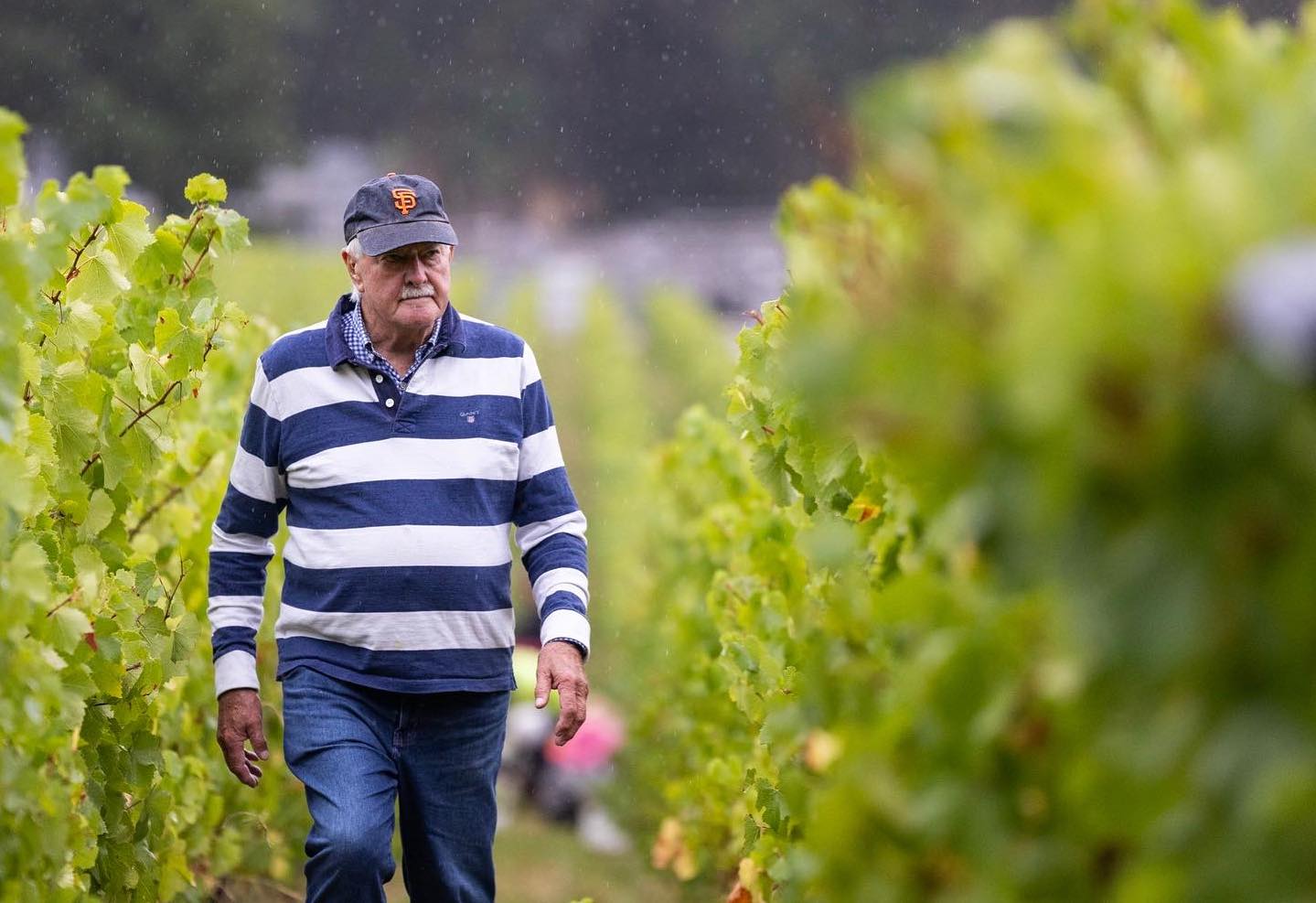
Highly decorated winemaker Brian Croser ponders the future of the Australian wine industry which he says is held back by a structure that is no longer fit for purpose.
Everyone knows the Australian wine industry is a basket case. We keep telling the world that is the diagnosis. Additionally, the industry projects forlorn hope of any recovery because of the apparent negative change in the global demand for wine.
There is no denying that big changes to the global wine industry are in train and inter alia this is ringing in change for the Australian wine community.
I would make the case those changes have been apparent and predictable for at least the past 25 years and that the strategy to make the necessary adjustments have been defined by the economic forensis applied to the historic performance of the global and Australian wine industry by economic analysts like Professor Kym Anderson. We can learn a lot about the future by the dispassionate analysis of the past as provided by Professor Anderson and his co-authors and Peter Bailey of Wine Australia.
What can’t be predicted is the response of the Australian wine community to the proffered analysis, their willingness to even read it, think about it and act on the evidential trail, finally developing a coherent strategy for the whole Australian wine industry free from sectorial and self-interest.
The willingness of the industry to assimilate the economic evidence and to act on it in a logical, concerted way is influenced by the perceived opportunity of the future.
The golden era for the modern Australian wine industry was from 1985 to 2001 during which production quadrupled, fuelled by export growth, against a domestic economic background at least as challenging as today. I know, I was there enduring it, 22 percent interest rates while trying to build a business.
United by the apparent market opportunity, the Australian wine community rang in the changes to create by 1994, an industry structure fit for purpose, that has largely remained unchanged to today, no longer fit for purpose.
Today the Australian wine community is fragmented around sectorial and self- interest, as what’s in the vineyards doesn’t match the changing wine market demand profile. The opportunity is confused by the lack of resolve to accept the economic evidence and to devise and adhere to a new whole-of-industry strategy.
The good news is that the required resources to adapt to the evolving market are still in place for the Australian wine community. They just have to be harnessed to the right strategy.
The false wars
The Australian wine community fundamentally recognises there are two distinct segments in our industry. On the one hand, the few very large bulk and branded commodity businesses built around the high productivity hot inland vineyards dominating chain retail shelves, and on the other the proliferation of small premium wine businesses mainly in the cooler coastal and highland regions, with their regional and individual stories, dependent on wine tourism, direct sales, on-premise and independent retail.
There is an historic rivalry between the two segments, as though what is good for one segment is bad for the other. The inland producers maintain all Australian wine is premium wine, that they are the engine room of the industry producing 70 percent of the wine by volume and paying most of the research and promotion levy and therefore should have the most say in its application.
To the extent such a numerous, disparate and fragmented premium wine community can agree on anything, they lament that Australia’s international premium wine reputation and image is detrimentally dominated by our discounted branded commodity wine segment. Australia has been pigeon-holed as a hot desert, irrigation dependent, industrial producer of branded commodity wine with a token cool climate offering.
So dominant is this perception that Tasmania has reputedly sought to separate its wine image from that of Australia’s, an act of marketing secession if not geographic.
Then there is the skirmish within the war, between the grapegrowers and winemakers, mainly in the inland areas, as though they are competing for a share of the same profits.
These are fictitious wars and battles, amplified by globally diminishing sales and profits.
There is another way. Both segments can mutually benefit, first by recognising the economic realities, then working together and developing a strategy to adapt to the changing marketplace.
Economic realities
The global market for non-premium wine has been shrinking for the last two decades, at about two percent per annum by value. This contraction is expected to continue in the future, displacing commodity grapes, mainly from high productivity vineyards in all the major wine producing countries.
Competitiveness in the global bulk and branded commodity market is driven by cost, price, scale and market power. Australia has been disproportionally successful with branded commodity wine in key export markets. Consistent with global trends the market for branded commodity wine in Australia is shrinking.
The global market for premium wine has been growing at three percent per annum by value over the same period, has paused currently but is expected to continue to grow into the future.
The premium wine market is changing, with preference drifting from traditional heavy red wines (Cabernets, Shiraz), to white, rosé, sparkling and lighter bodied reds (Pinot Noir, Grenache).
Competitiveness in the global premium wine marketplace is driven by wine quality and style and the authentic regional and producer stories that define the country and regional image in that marketplace. Australia has been disproportionally unsuccessful in key premium wine export markets.
The Australian domestic market for premium wine is growing (20-year average of six percent per annum by volume) but imported wine is taking a disproportionate share, currently at 30 percent of market value and growing at three percent per annum.
Australian investment in grape and wine R&D has been diminishing in actual dollar and purchasing power for the past two decades. Given the proven superior returns R&D investment has provided the Australian wine community in the past, there is an imperative to reverse this decay.
Additionally, the priority of Australian R&D investment has dramatically shifted from grape and wine quality improvement and resilience, to extension and so-called industry capacity building. If the Australian wine community is to succeed in the premium wine markets of the future, it needs to reinvest in grape and wine quality improvement and adaptation to climate change.
Red herrings
In the analysis of the Australian wine industry’s history, the bubble of US growth from 2000 to 2008 and the bubble of Chinese growth from 2010 to 2020 should both be ignored.
The US flirted with overripe Australian Shiraz and became disenchanted with the variety, style and Australian wine. It disappeared down the drain.
The Chinese flirted with wine in general and the promise of investment triggered visas in Australia.
Chairman Xi ended the romance.
Both of those markets are returning to their pre-bubble status, the US way under- indexing in the success factors for Australian premium wine in tune with our traditional European markets.
A strategy
Professor Anderson handed the Australian wine industry the insights that would enable it to escape its malaise, in his paper ‘Globalisation and national commodity cycles: the case of wine in Australia.’
He compared the resilience and success of the Californian and New Zealand wine industries to Australia’s failing industry. He identified the steep inverted V of the measures of Australia’s international competitiveness in wine from 1985 to 2023, peaking in 2001. New Zealand and the US industries are dominated by their premium wine offerings. Australia by contrast is dominated by its non-premium offerings. Therein lies a learning and a message.
Australian winemakers are not in control of their own industry strategy because of disunity, the ‘false wars’ and the disfunction of the plethora of industry bodies including Wine Australia, to which the government dictates a majority of non-industry key appointments.
Australia’s biggest market failure is that of premium wine in our traditional European and American continent markets. Add to that market failure, the growing invasion of expensive imported wine into the Australian domestic market, and the largest opportunities for future profitable growth for Australian premium wine have been identified.
How do we unlock those markets for Australian premium wine? By sustained promotion of our premium wine regions and the winemakers, their terroirs and stories, to reverse the adverse image of Australia as a premium wine producer. That promotion is necessary in export and the domestic markets.
How do we fund sustained effective promotion? By industry levy based on value not volume where the large companies do not get a discount because of their size. The imperative is for the industry to devise and control this promotion.
What is the effect of this promotional strategy on the non-premium wine producers? There are no negative consequences for the branded commodity and bulk producers and there is upside from the improving image of Australia as a supplier of wine. A value-based levy treats non-premium producers more equitably than the current volume-based levy.
In what other ways can premium Australian wine become more competitive in all markets?
Improving grape and wine quality provides a sustainable competitive advantage in all markets.
That applies to non-premium as well as premium wine. Promoting the effort and dedication to quality improvement moves the Australian wine image dial in the right direction.
How can grape and wine quality be continuously improved?
Primarily by investing in research in vineyard and winery to understand and control the drivers of wine quality and to provide the extension and education infrastructure to enable industry to apply the research learnings.
How is this research to be funded? By an increased value-based levy to replace the current volume-based levy, matched by Commonwealth funds. Again, the industry needs to control the application of the funds to avoid their dissipation to less effective projects. Again, for non-premium producers, there is no detriment, there are significant research benefits, and the levy is more equitable.
These are the positive initiatives the industry strategy should embrace.
In defence of non-premium wine
Just in case this paper is misinterpreted as a continuation of the ‘false war’, Australia has and needs to have a viable and vibrant non- premium wine segment. It supplies a yawning domestic market opportunity where it has a considerable competitive advantage, and it very successfully occupies a significant place in export bulk and branded commodity export markets. The vast overhang of inventory and fruit at harvest threaten its ongoing viability by destroying grape and wine pricing power.
The large and necessary supply adjustment to the non-premium grape and wine segment seems to be gaining momentum. This is a necessary and painful adjustment that should have happened incrementally over the past 20 years. Once supply-demand balance is restored, the expected continuing diminution of the global non-premium wine market should continuously inform the commercial decisions of Australian grapegrowers and winemakers. The considered balancing of supply and demand for the non-premium segment is a necessary defensive strategy. That doesn’t preclude applied technology and will power elevating the best of inland region fruit into the ranks of premium.
The defence of our non-premium wine segment should be a part of the whole-of- industry informed strategy, founded on economic evidence and constructed without fear or favour to sectorial or self-interest.
Oh, for a perfect world!
• This article first appeared in the January-February 2026 issue of WBM – Australia’s Wine Business Magazine. To read stories like this and more please subscribe here. Serving the Australian wine industry since 2005.
Related content














Recent Comments