
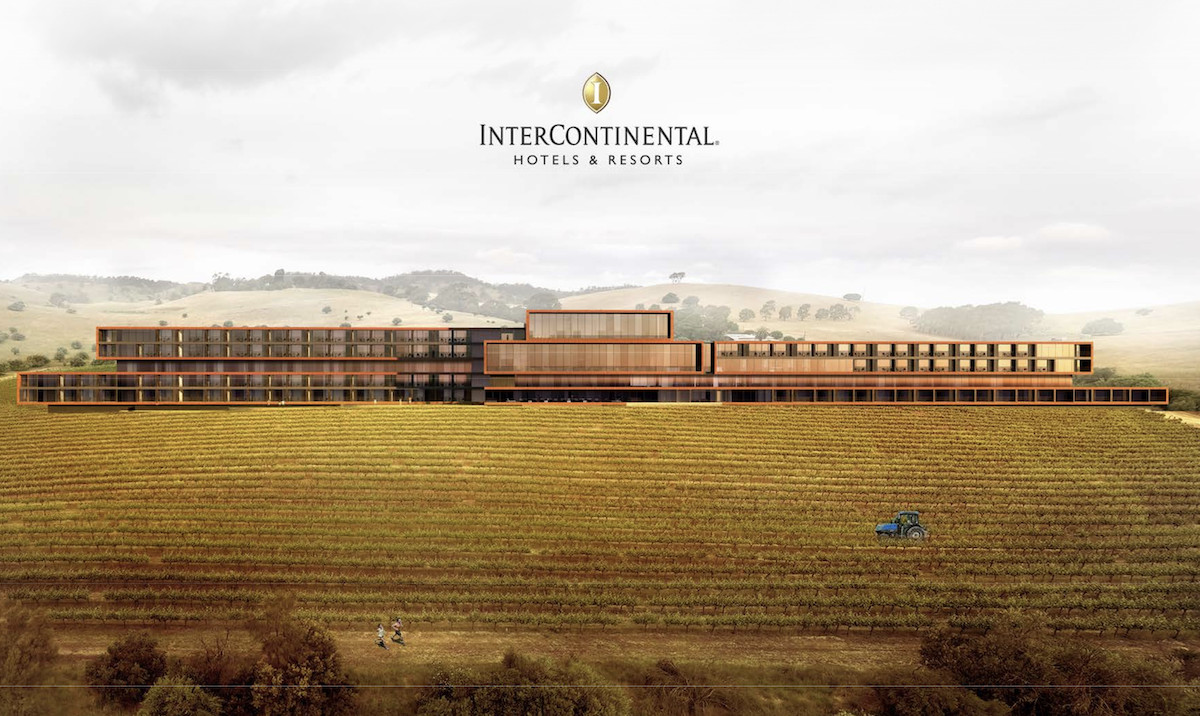
Barossa wine identity Matthew McCulloch is one of a group of residents who tried to stop the InterContinental Barossa Resort & Spa from going ahead. He responds to the project getting the green light.
Seventy-three percent of public submissions oppose this development, and nearly 1,500 people have so far signed a petition asking the Minister not to approve it.
The neighbouring tourism businesses, which some think would benefit from this development, oppose it. That’s Barossa Helicopters, The Dairyman Barossa and the Lyndoch Lavender Farm & Café in case you’re wondering.
The South Australian Government Architect, Office for Design and Architecture SA (ODASA), does not support this development’s design.
Barossa Council believes there are challenges with the proposed scale, planning and infrastructure requiring further review and analysis to ensure alignment with the Character Preservation Act, and it supports further design refinement (in conjunction with ODASA), ‘to better anchor the hotel within the landscape and to reduce visual dominance.’
In Geber Super Pty Ltd v The Barossa Assessment Panel [2023] SASC 154, the Supreme Court of South Australia quashed a decision approving a proposed tourist accommodation development in Tanunda. It found that the proposal was seriously at variance with the Planning and Design Code. It also provided observations on the Code’s application.
It held that the provisions of the Rural Zone necessitated a link between any proposal for tourist accommodation and a primary production use of the land, or a primary production value-adding industry, which the proposal did not satisfy. The proposed stand-alone tourist accommodation development had no such association and was of a scale considered fundamentally at variance with the relevant policies in the Code.
The unintended consequence of this judgment was that the property developer behind the SBWTAP, Strategic Alliance, included a winery and vineyard component in its development application to navigate the precedent set by the judgment.
In the Department for Housing and Urban Development’s assessment report, it states that ‘the winery and vineyards are to be leased to an undisclosed third party (but is an existing Barossa Valley wine label/operator)’ and refers to ‘an established Barossa-based wine label’.
Those are weasel words. Not an undisclosed grapegrower, winemaker, winery or wine company with skin in the game, but a ‘wine label’.
The identity and size of the ‘wine label’ is material, given the Supreme Court’s reference to scale regarding the relevant policies in the Code. Is this undisclosed third party a one-tonne ‘wine label’ or a 500-tonne (below 500 tonnes, no Environment Protection Authority licence is required) ‘wine label’? Therefore, should this hotel development be a 15 or 150-bed hotel?
The South Australian Country Fire Service (CFS) does not support the assertion by SA Bushfire Solutions that multiple access routes are not required, as the emergency management planning for the site proposes early evacuation (before a designated Catastrophic fire danger day) or ‘shelter in place’, saying that contingencies are necessary to mitigate risks not only to guests and staff on-site, but also to emergency first responders and neighbouring residents and businesses.
SA Bushfire Solutions notes that ‘the bushfire risk assessment and supporting traffic documentation acknowledge geometric constraints at the intersection of Hoffnungsthal Road and Lindner Road, including limitations on simultaneous passage of emergency vehicles and general traffic, and the restricted ability to significantly widen the intersection due to regulated and/or significant trees.’
The hotel is a six-storey building, and specialist firefighting equipment and/or expertise may be required that is not available at regional CFS facilities.
Unanswered questions
Why have a Character Preservation Act, Character Preservation Districts and Significant Landscape Protection Overlays if they’re ignored at the first challenge? Does planning law serve as genuine protection, or is it merely administrative theatre that can be circumvented through ministerial discretion?
Astonishingly, in section 7.12 of the Department for Housing and Urban Development’s assessment report, it states that ‘No comment was received from the Minister Administering the Character Preservation (Barossa Valley) Act 2012.’ That’s Minister Champion in case you’re wondering.
How does a six-storey, 243 metre wide, 14,000 square metre hotel located within a vineyard in the foothills of the Barossa Range – which public submissions variously describe as an apartment building, a block, boxes, a detention centre, an eyesore, a gulag, an office block, a prison, a scar on the landscape, a school and shipping containers – recognise, protect and enhance the special character of the Barossa Valley or conserve the natural and rural character and scenic and cultural qualities of its significant landscapes?
During the assessment process, why did the chief executive of the South Australian Government’s Department for Housing and Urban Development, David Reynolds PSM, take over responsibility for the assessment report and its recommendations for ministerial consideration from the State Planning Commission (SPC), an independent, at-arm’s-length body providing advice and leadership on all aspects of planning and development in South Australia and the state’s principal development assessment and planning advisory body?
Why was SBWTAP approved when, in February 2026, the State Commission Assessment Panel (SCAP), a committee of the SPC, refused planning consent for the Sandy Creek Resort, a competing development in the Rural Living Zone within the Character Preservation District and the Significant Landscape Protection Overlay at nearby Sandy Creek?
The SCAP resolved that:
- The development is not a complementary non-residential use nor is it compatible with a secluded semi-rural or semi-natural residential character.
- The development would not complement the semi-rural or semi-natural residential character and amenity, and is not ancillary to a dwelling erected on the same allotment.
- The proposed siting and design would not complement the semi-rural or semi-natural residential character and amenity.
The Presiding Member of the SCAP from 2020 until 2025 was Rebecca Thomas. She is a director of Ekistics, the company engaged by the SBWTAP applicant and property developer, Strategic Alliance, and the team leader for this project.
How will the suggested biosecurity mitigation measures (contractor/visitor education, fencing and signage) to counter the risks associated with increased visitation to the locality stop phylloxera, which could be brought to the site by visitors who may have recently visited any of the Victorian wine regions within the six Phylloxera Infested Zones, including Beechworth, Goulburn Valley, King Valley, Nagambie, Rutherglen and Yarra Valley?
Why has the scoping and feasibility study, undertaken by the consultant Hotellerie, which underpins the apparent commercial need for this development, not been made public?
It apparently investigated and determined the economic viability/underlying demand for tourist accommodation in the Barossa Valley region and identified a general need (and opportunity) for a ‘mid-level, 5-star resort-style’ hotel to cater for longer-length stays and conference market segments.
With Nexus, Lyndoch and Oscar Seppeltsfield approved, does Barossa need yet another hotel development away from the towns? Some analysts have warned that rapidly increased room supply will weigh on occupancy rates if demand doesn’t keep pace, particularly outside peak event periods. Nexus and Oscar will add 195 rooms to the current 1,311 rooms across 130 accommodation establishments, representing a substantial increase that will test market absorption capacity over the coming years, when current occupancy rates are below 60 percent. When is enough enough?
For the broader community, this approval reflects the Minister for Planning’s deliberate policy choice to prioritise economic diversification and tourism investment in Barossa over character preservation arguments. This choice is lawfully available under the Planning, Development and Infrastructure Act impact assessment pathway, even if it sits in tension with the Character Preservation Act’s underlying intent.
That tension, openly acknowledged in the Department for Housing and Urban Development’s s assessment report, is the most consequential unresolved issue in this entire process.
This approval, along with the controversy surrounding the construction of Festival Tower Two and the North Adelaide golf course redevelopment, reflects this government’s tyranny of the majority and its belief that its numbers justify any action, and an aggressive and arrogant approach to major developments, with an insatiable desire for economic activity and a prioritisation of profit over people.
• Subscribe to the beautiful printed edition of WBM – Australia’s Wine Business Magazine here.
Related content









Recent Comments