

Australian wine exports fell by 14 percent to $2.28 billion and seven percent in volume to 603 million litres in the 12 months ended March 2026, according to Wine Australia
Total volume was 15 percent below the 10-year average of 711 million litres.
The year-on-year decline in both volume and value was heavily influenced by shipments to mainland China stabilising two years after import tariffs on bottled Australian wine were removed.
While markets such as the United Kingdom (UK) and the United States (US) also experienced a decline in wine exports, momentum is building elsewhere.
Canada delivered strong growth, with export value up 24 percent, while demand across destinations in Asia, excluding mainland China and Hong Kong, saw exports to the region grow by 19 percent in value.
In the 12 months to March 2026, 1,545 exporting businesses shipped Australian wine to 111 destinations.
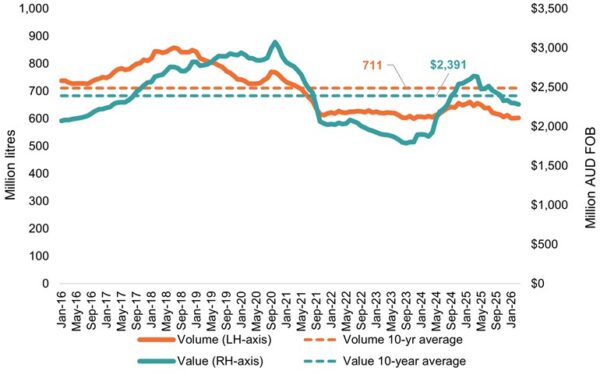
Rolling 12-month volume and value of Australian wine exports.
The largest region by volume for Australian wine exports is Europe, which declined by nine percent to 265 million litres in the past 12 months.
The largest driver of the decline was shipments to the UK, followed by Germany.
However, there were some positive results in packaged exports to the Netherlands and unpackaged exports to Denmark. Exports to Spain also grew, but it is likely that this wine is being on-shipped to other European destinations.
Exports to Australia’s second largest export region, North America, increased by five percent in volume to 174 million litres, owing to strong growth in exports to Canada outweighing a decline in exports to the US.
There were mixed results across destinations in Asia.
While exports to mainland China and Hong Kong declined, shipment levels increased to many other major destinations – including Singapore, Thailand, Malaysia, Indonesia, Japan and South Korea.
Mainland China
Exports to mainland China declined by 29 percent in value to $728 million and 25 percent in volume to 73 million litres.
The average value of exports declined by six percent to $10.03 per litre.
Import tariffs on Australian bottled wine were removed in late March 2024. In the following year, shipments increased rapidly, with value recovering nearly to levels seen before tariffs (notably this was not also the case for volume). In the past 12 months, shipment levels have been adjusting to meet market demand with volume and value stabilising, particularly in the past six months.
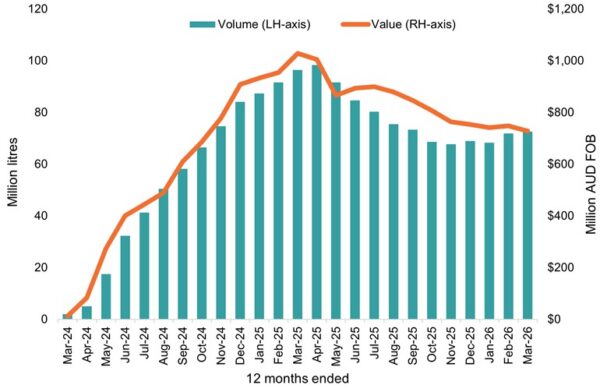
Australian wine exports to mainland China.
United Kingdom
Australian wine exports to the UK declined by five percent in value to $336 million and nine percent in volume to 190 million litres.
The decrease is a continuation of the long-term decline in shipment volume after increases in the Covid-19 era.
The downward trend has been exacerbated in recent times by increasing costs, including the new alcohol duty regime introduced in 2024, and suppressed demand due to ongoing cost-of-living concerns.
About 91 percent of exports to the UK are unpackaged (to be bottled in-market). Unpackaged exports declined by seven percent in volume, while packaged exports declined by 18 percent in volume.
However, premium exports (with an average value of $10 per litre and above) grew by 16 percent in volume in the past 12 months and by an average of five percent per year over the past five years.
This growth was driven by many of the major varieties – including Shiraz, Chardonnay, Cabernet Sauvignon and Pinot Noir.
United States
Australian wine exports to the US declined by 22 percent in value to $251 million and one percent in volume to 105 million litres.
The average value of exports declined by 21 percent to $2.39 per litre FOB.
More than 90 percent of the decline in value came from exports priced between $2.50 and $4.99 per litre FOB.
This is reflective of a nine percent decline in the overall market segments valued at US$4 and US$11 per bottle in the US – more than 90 percent of Australian wine sales in the US are within these segments.
According to IWSR, wines sales in the US declined by six percent in volume in 2025, driven by the cost-of-living crisis.
The consumer confidence index in the US has fallen to 96.6, according to the OECD, indicating a more pessimistic outlook on the future than other Western economies (Australia and the UK are both around 100 – indicating a neutral outlook).
Consumers are becoming very selective in their alcohol choices. This is reflected in sales figures by price segment, where the market above $15 per bottle has been much more resilient than lower price segments.
Nevertheless, because of this consumer uncertainty and tariffs increasing costs for importers and producers, all major sources of imported wine have declined in value in the past 12 months, including France, Italy, New Zealand and Spain.
Canada
Australian wine exports to Canada increased by 24 percent in value to $188 million and 15 percent in volume to 69 million litres.
The average value per litre increased by eight percent to $2.73 per litre FOB.
Over the past year, many Australian brands have experienced an increase in sales in Canada, following the removal of American wines across Canadian liquor boards in response to US tariffs on Canadian products, which were imposed in early 2025.
Australian wine has performed very well compared to other source countries – growing by 29 percent in sales volume year-on-year in Ontario, five percent in British Columbia and four percent in Quebec.
The market leading performance in Ontario has translated to a growth in Australia’s market share in the province from six to nine percent over the past year.
The growth in exports to Canada has come from across the price spectrum, although wines above $5 per litre have grown at slightly stronger rates.
Cabernet Sauvignon is the key growth varietal, with many Australian regions performing well.
Asia
Asia, excluding mainland China and Hong Kong, grew by 19 percent in value to $393 million and seven percent in volume to 44 million litres.
This represents an acceleration of a long-term growth trend (7 per cent in value per year over the past five years).
The key drivers were Singapore (a key shipment hub in the region) and the emerging wine markets of Thailand and Malaysia.
Exports to Thailand increased to a record value of $64 million.
Importantly, the more developed wine markets of Japan and South Korea also experienced growth – by 10 and six percent respectively.
• Subscribe to the beautiful printed edition of WBM – Australia’s Wine Business Magazine here.
Related content














Recent Comments