

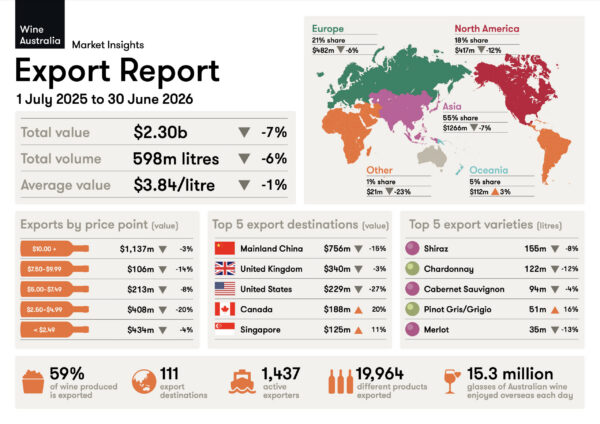
Australian wine exports declined by seven percent in value to $2.30 billion and six percent in volume to 598 million litres in the year ended June 2026, according to Wine Australia’s Export Report.
This is the first time that export volume has fallen below 600 million litres since 2004.
However, the decline mirrors a broader global trend of declining wine consumption over the past decade.
The total export figures reflect increasingly difficult trading conditions across many of Australia’s key export markets, driven by a historic downturn in global wine consumption.
Worldwide wine consumption has fallen to its lowest level since 1961, as consumers increasingly moderate alcohol intake, face cost-of-living pressures and shift towards alternative beverages.
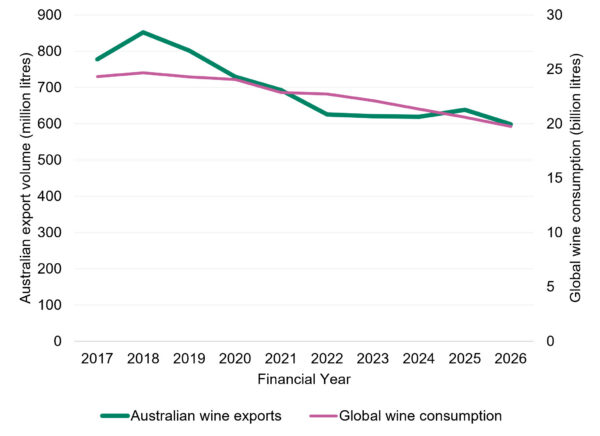
Figure 1. Australia wine exports compared to global wine consumption.
Wine Australia manager, Market Insights, Peter Bailey said the challenges facing Australian wine exporters are not unique, with other wine producing nations facing the same conditions.
“Data from multiple sources suggests the decline in wine consumption globally is more than a short-term downturn – it’s a reflection of changing consumer behaviour that is reshaping demand around the world,” he said.
“This reinforces the importance of understanding where demand exists and the products and occasions that are driving consumer decisions.
“While global trading conditions remain challenging, Australia wine continues to perform relatively well in many key markets where it generally maintained or grew its share of imported wine over the past year.”
The decline in Australian wine exports for the year ended June 2026 was driven primarily by weaker demand in Australia’s three largest export markets – mainland China, the United Kingdom and the United States.
Mainland China remained Australia’s largest export market by value, despite exports falling 15 percent to $756 million as the initial post-tariff recovery and restocking phase came to an end.
“While exports to mainland China declined over the past year, Australia remains the leading source of imported wine in the market,” Mr Bailey said.
“The market is no longer being driven by the restocking of Australian wine, rather we’re seeing a more mature and demand-led phase, reflecting a smaller and slower-growing Chinese wine market than existed prior to the imposition of tariffs in late 2020.”
25 year low
The United Kingdom remained Australia’s largest market by volume and the United States second, although export volume to both markets fell to their lowest level in 25 years.
“While trading conditions in the UK remain challenging, Australia continues to hold the leading share of the UK off-trade market, reflecting the long-standing popularity of Australian wine among British consumers,” Mr Bailey said.
“Most of the decline is coming from commercial and mid-priced wines.
“Higher-value Australian wines have been more resilient and continue to attract demand in the UK market.
“Unlike the UK, where premium wines have remained relatively resilient, the US data points to weaker demand across most price categories. This suggests Australia’s challenges in the US extend beyond entry-level wines and reflect wider market headwinds, including declining wine consumption, increased competition from domestic and imported producers, retailer inventory reductions, and changing consumer preferences toward alternative alcoholic beverages.”
Despite the broader slowdown, several markets delivered strong growth.
Canada performs
“Canada was a standout performer, with export value increasing 20 percent to $188 million – its highest level in seven years – and volume rising 13 percent,” Mr Bailey said.
“This growth stands out against a backdrop of declining wine consumption generally in Canada, with Australia’s growth supported by market-share gains following reduced availability of US wines during the Canada-US trade dispute.
“This growth momentum softened towards the end of the period suggesting this market-share gain is beginning to stabilise.
“Asian markets outside mainland China also delivered strong growth. Export value increased significantly in Singapore, Thailand, Malaysia, Japan, South Korea and Taiwan. Singapore became Australia’s largest Asian market outside of mainland China, while Thailand achieved record export values driven by growing demand for premium Australian wines.”
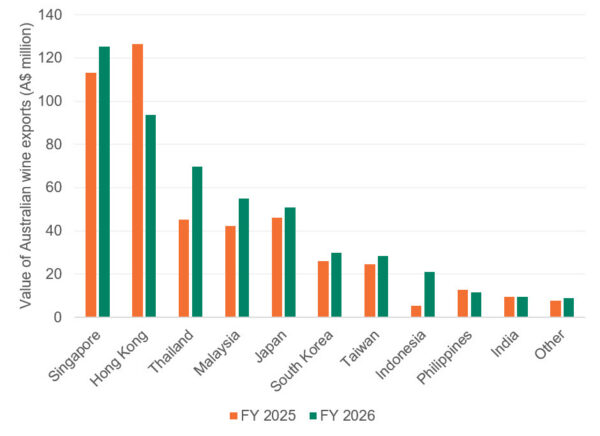
Figure 2. Value of exports to key Asian destinations (excluding mainland China).
Top five markets by value
Mainland China, down 15 percent to $756 million.
United Kingdom, down three percent to $340 million.
United States, down 27 percent to $229 million.
Canada, up 20 percent to $188 million.
Singapore, up 11 percent to $125 million.
Top five markets by volume
United Kingdom, down six percent to 192 million litres.
United States, down 15 percent to 95 million litres.
Mainland China, down eight percent to 77 million litres.
Canada, up 13 percent to 69 million litres.
New Zealand, up one percent to 26 million litres.
• Subscribe to the beautiful printed edition of WBM – Australia’s Wine Business Magazine here.
Related content














Recent Comments